

Old Soccer Ball Guide: Identify, Value & Care
Table of Contents
- Why Old Soccer Balls Still Matter to Collectors
- Old Soccer Ball History: From Laces to Synthetics
- How to Tell If a Soccer Ball Is Vintage
- Vintage Soccer Ball Value: What Affects the Price
- How to Clean a Leather Soccer Ball Without Causing Damage
- Displaying and Preserving Old Soccer Balls
- Where to Find and Sell Old Soccer Balls
- Frequently Asked Questions
Last Updated: October 6, 2026
Why Old Soccer Balls Still Matter to Collectors
An old soccer ball is a leather or synthetic football made decades ago, kept for its history, look, and connection to the game's past.
This guide covers how to date a ball, what drives its price, how to clean leather without wrecking it, and where to buy or sell. It is written for anyone who found a dusty ball in a garage and wondered if it mattered.
Old Soccer Ball History: From Laces to Synthetics
The old soccer ball changed more in the last 60 years than in the previous 100. Two shifts drive everything collectors care about: the move from laced leather to stitched panels, and the move from leather to synthetic covers. But history only helps if you can use it to date a ball, so this section pairs each era with the physical clues that survive on the object itself.

The Leather Era and the Rise of the Soccer Ball with Laces
Early balls used heavy leather panels stitched together, with a lace opening to insert and tie off the bladder. The FIFA's history of the Laws of the Game documents how the game standardized around these designs over the twentieth century.
Leather balls absorb water, gain weight in the rain, and dry out over time. That is why so few survive in good shape.
World Cup Eras and the Shift to Synthetic Panels
The 1970s and 1980s brought synthetic covers and glued or heat-bonded panels. World Cup balls from the 1990 and 1998 tournaments are among the most collected models, and their designs are easy to date by panel shape and print. These balls kept their shape far better than leather, which is why more of them turn up today.
How to Date an Old Soccer Ball: A Practical Timeline
Use this sequence to narrow a ball to a rough decade. Work from the most obvious feature to the least, and stop when the clues agree.
- Pre-1930s: Heavy leather panels, visible hand stitching, a lace opening, and often no maker mark at all. Balls were frequently re-inflated through the lace, so the opening is usually worn.
- 1930s-1960s: Leather panels with a lace, but with printed or stamped maker marks and country of origin. Panel counts are often lower, with larger, fewer panels.
- 1970s: The transition decade. You can find leather balls with laces alongside early synthetic balls with stitched panels. Check the cover material by feel and by how it has aged.
- 1980s: Synthetic covers become dominant. Panels are glued or heat-bonded rather than stitched, and the surface may show a printed pattern rather than a stitched one.
- 1990s onward: Molded or thermally bonded panels, printed graphics, and model names or tournament branding that can be matched to a specific year.
The Clues That Actually Date a Ball
Markings, panel construction, materials, and manufacturing details do most of the work. Check them in this order:
- Laces: A lace opening points to the leather era. Its absence usually means synthetic or a later replica.
- Panels: Count them. Old balls often used fewer, larger panels. Modern balls use more, smaller panels for a rounder flight.
- Stitching: Hand stitching looks uneven. Machine stitching is regular. Glued or bonded seams have no thread at all.
- Branding: Look for maker marks, country of origin, and any model or tournament name. These are the fastest way to anchor a decade.
- Material: Leather stiffens and darkens. Early synthetics can feel waxy or slightly tacky as they age. Modern plastic stays flexible and glossy.
Why the Timeline Matters for Value
Dating is not just trivia. A ball placed in the right decade can move from a curiosity to a collectible, because buyers pay for era-specific details. A leather ball with a lace and a maker mark sits in a different market than a 1990s synthetic with printed graphics. Get the decade right first, then judge condition and provenance.
How to Tell If a Soccer Ball Is Vintage
A vintage soccer ball usually shows three signs: aging leather or early synthetic material, stitched or laced construction, and branding that matches a known era. If a ball looks old but feels like modern plastic, it is probably a replica.
Key Markers: Stitching, Panels, and Branding
Check these points in order:
- Laces: A lace opening points to the leather era.
- Panels: Count them. Old balls often used fewer, larger panels.
- Stitching: Hand stitching looks uneven. Machine stitching is regular.
- Branding: Look for maker marks and country of origin.
- Weight: Heavy, stiff leather suggests real age.
Vintage Soccer Ball Value: What Affects the Price
Vintage soccer ball value comes down to four things: condition, rarity, provenance, and demand for that era. A rare ball in poor shape often sells for less than a common ball in great shape. But value only matters if the ball is genuine, so this section covers the factors, the authentication checks, and the market mechanics that competitors usually skip.
Condition, Rarity, and Provenance
Factor |
What Raises Value |
What Kills Value |
|---|---|---|
Condition |
Intact panels, clean leather |
Cracks, rot, missing lace |
Rarity |
Short-run or match-used balls |
Mass-produced models |
Provenance |
Papers, photos, match records |
No history at all |
Era |
World Cup years, early leather |
Recent replicas |
Provenance is the hardest part to fake and the easiest to lose. Keep any paperwork, photos, or match notes with the ball.
How to Authenticate an Old Soccer Ball
Authentication is where most owners get stuck. Work through these checks before you accept a ball as genuine:
- Compare the stitching to the era. Hand stitching belongs on leather-era balls. Regular machine stitching or bonded seams belong on later balls. A mismatch is a red flag.
- Check the branding against known makers. A mark that does not match the claimed decade, or a logo that looks too crisp for the age, suggests a reproduction.
- Look for wear patterns that match use. Real match balls show scuffing, seam stress, and uneven patina. A ball that is uniformly "aged" often was not played with.
- Inspect the lace and bladder opening. Original laces are usually stiff, frayed, or replaced. A perfectly new lace on an old ball is unusual.
- Ask for provenance in writing. Photos, match programs, or a chain of ownership do more for value than any single feature.
A common pattern is a ball that passes the visual test but fails the material test: it looks old, but the cover feels like modern plastic. When the clues disagree, trust the material and the construction, not the finish.
Vintage "DAD" Soccer Ball (Tan) →
What Actually Moves the Price
Beyond the four factors, a few practical realities shape what a ball sells for:
- Match-used beats mass-produced. A ball tied to a specific game or team usually outperforms an identical model bought retail.
- Completeness matters. Original lace, bladder, and any packaging or paperwork add value.
- Display appeal matters. Balls that photograph well and sit stably on a shelf attract more buyers.
- Demand is era-specific. World Cup years and early leather tend to draw the most consistent interest.
Buying and Selling Without Getting Burned
If you are buying, ask for photos of the stitching, lace, branding, and any damage before you commit. If you are selling, photograph those same details and describe the condition honestly. Overstating condition is the fastest way to lose a buyer and damage your reputation.
When a Ball Is Not Worth Restoring
Not every old ball deserves restoration. If the leather is cracked through, the panels are separating, or the bladder opening is torn, restoration costs can exceed the ball's value. In those cases, display it as-is or consider reuse rather than repair. The goal is to preserve what is genuine, not to make an old ball look new.
How to Clean a Leather Soccer Ball Without Causing Damage
Cleaning a leather soccer ball is a slow, gentle job. Use a soft dry cloth first, then a barely damp cloth, then a leather conditioner made for smooth leather. Never soak it, never scrub it, and never use household cleaners.
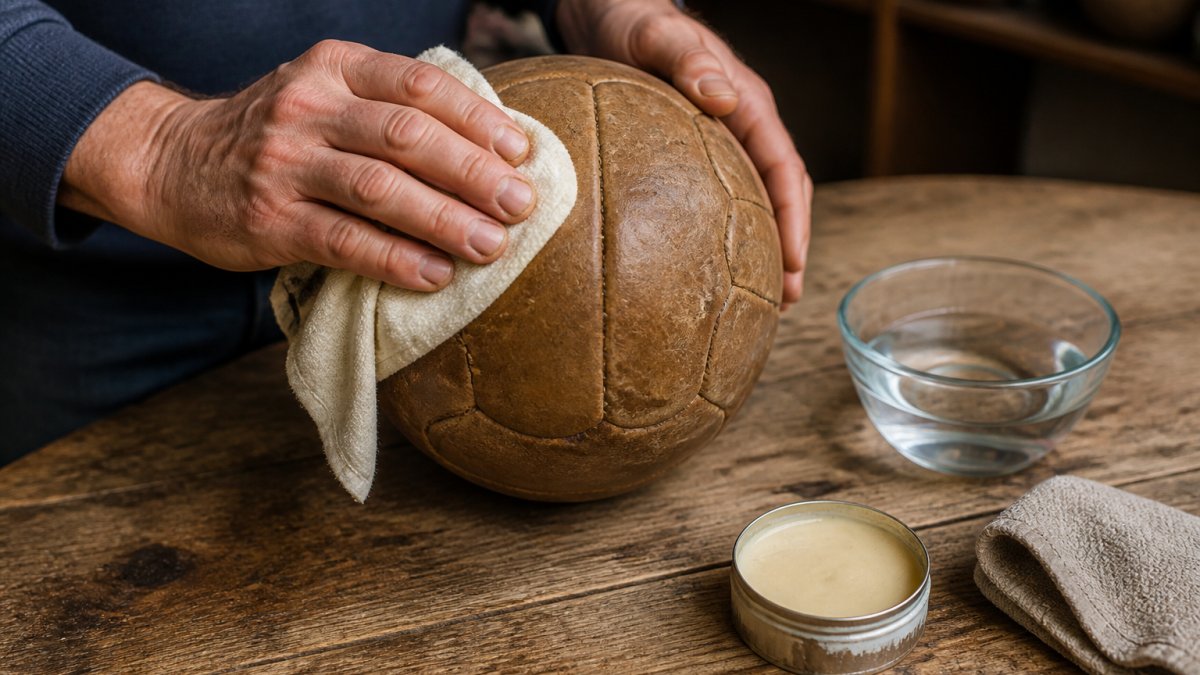
Step-by-Step Cleaning and Conditioning
- Dust the ball with a dry, soft cloth.
- Wipe with a damp cloth. Wring it out first.
- Let it air dry away from heat and sun.
- Apply a small amount of leather conditioner.
- Buff off the excess with a clean cloth.
- Store it out of direct light.
Test any product on a hidden panel first. Leather that is already cracked will not recover, and too much moisture can speed up rot.
Displaying and Preserving Old Soccer Balls
A preserved ball keeps its value. Store it in a dry room, away from sunlight and heat, and keep it off bare shelves where it can roll or fall. A dedicated football tee display holds the ball in place and stops flat spots from forming.
Avoid plastic bags, which trap moisture. A breathable cotton bag or open shelf is better. Rotate the ball every few months if it sits on a stand.
Where to Find and Sell Old Soccer Balls
Old soccer balls turn up in house clearances, estate sales, charity shops, and online marketplaces. If you are buying, ask for photos of the stitching, lace, and branding before you commit.

For buyers who want a guaranteed look without the guesswork, our range of vintage-style soccer balls offers an old-school finish with no restoration risk. We also stock a black leather version and coach-themed balls for display.

Frequently Asked Questions
Why did old soccer balls have laces?
Early soccer balls used laces to close the opening where the bladder was inserted. Before synthetic materials, the bladder was made of rubber and had to be placed inside the leather panels through a slit. Laces kept that slit closed and allowed players to tighten the ball. The soccer ball with laces was standard until the 1960s, when valve technology made laces obsolete.
How can you tell if a soccer ball is vintage?
Check for laces, which usually indicate pre-1960s manufacturing. Look at the stitching: hand-stitched panels, visible thread, and irregular seams point to an older ball. Leather panels that have darkened or cracked with age are another sign. Branding can also help: older balls often have stamped or embossed lettering rather than printed logos. If the ball has a synthetic surface and a valve, it is likely post-1970s.
Are old leather soccer balls safe to use?
Most vintage leather soccer balls are not safe for regular play. Age weakens the leather, and the stitching can fail under stress. Old bladders may not hold air reliably. If you want to kick a ball, use a modern replica instead. Keep vintage balls for display or light handling. If you do inflate an old ball, use low pressure and check for cracks before every use.
How should you clean and store an old soccer ball?
Clean a leather soccer ball with a soft, damp cloth. Avoid soaking the leather. After cleaning, apply a leather conditioner to prevent drying and cracking. Store the ball in a cool, dry place away from direct sunlight. Use a display stand or a football tee to keep it off the ground. Avoid plastic bags, which trap moisture and can cause mould.
Hunting for a genuine old soccer ball takes patience, and most finds need work before they look good on display. If you would rather skip the search, Vintage Footballs offers vintage-style leather soccer balls with classic lacing and stitched lettering, plus autographed limited edition player balls and football tee displays to hold them. Browse the collection and subscribe to our emails for new arrivals.